Test Oracles, Metamorphic Testing, Back-to-Back Testing, and A/B Testing
Teach AI-specific test design techniques for systems where exact expected outputs are unavailable or unstable.
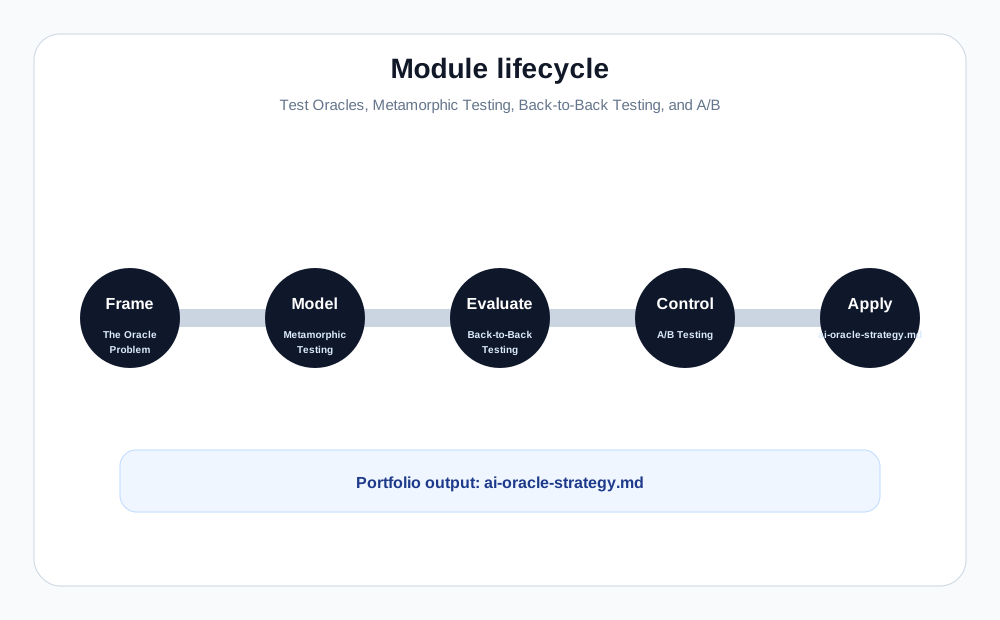
Test Oracles, Metamorphic Testing, Back-to-Back Testing, and A/B Testing video briefing
A focused explanation of chapter 6, turning the AI testing theory into concrete validation checks.
Briefing focus
Module opening
This is a structured lesson briefing. Real video/audio can be added later as a media source.
Estimated time
9 min
- 1Module opening
- 2Learning objectives
- 3Mind map
- 4Scenario evidence breakdown
Transcript brief
Teach AI-specific test design techniques for systems where exact expected outputs are unavailable or unstable. The briefing explains why the topic matters, walks through a failure scenario, and identifies the artefacts a tester should produce for evidence and auditability.
Key takeaways
- Connect the AI risk to a measurable test or monitor.
- Document the evidence needed for reproducibility and audit.
- Use the lab or scenario to practise the validation workflow.
Module opening
Teach AI-specific test design techniques for systems where exact expected outputs are unavailable or unstable.
Audience. Manual and automation testers designing reliable tests for probabilistic systems.
Why this matters. AI often lacks one perfect expected answer. Good testers design alternative oracles: relations, comparisons, thresholds, reviewers, and production experiments.
ISTQB CT-AI mapping. CT-AI 8.7, 9.4, 9.5
Trainer note
Start with the scenario before the theory. Ask learners what evidence would make them confident, then use the module to build that evidence step by step.
Learning objectives
- Explain the core quality risk in test oracles, metamorphic testing, back-to-back testing, and a/b testing.
- Select practical test evidence that supports an AI release decision.
- Apply the module concepts to a realistic QA scenario.
- Produce a portfolio artifact that can be reused in a professional AI testing context.
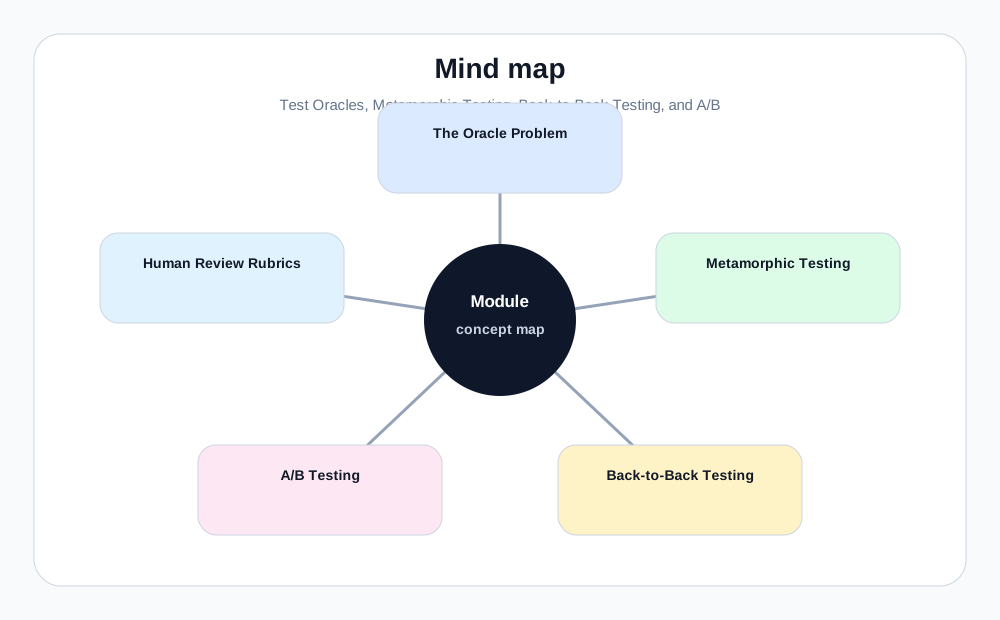
Mind map
Real-life scenario · Travel booking
The travel recommender with no single correct answer
Situation. A recommender ranks hotels and activities for a user profile. The team could not assert exact recommendations, so regressions slipped through when irrelevant hotels started ranking highly.
Lesson. AI testing is strongest when risks, examples, evidence, and release decisions are connected.
Scenario evidence breakdown
| Scenario element | Detail |
|---|---|
| Product/System | Holiday recommendation app |
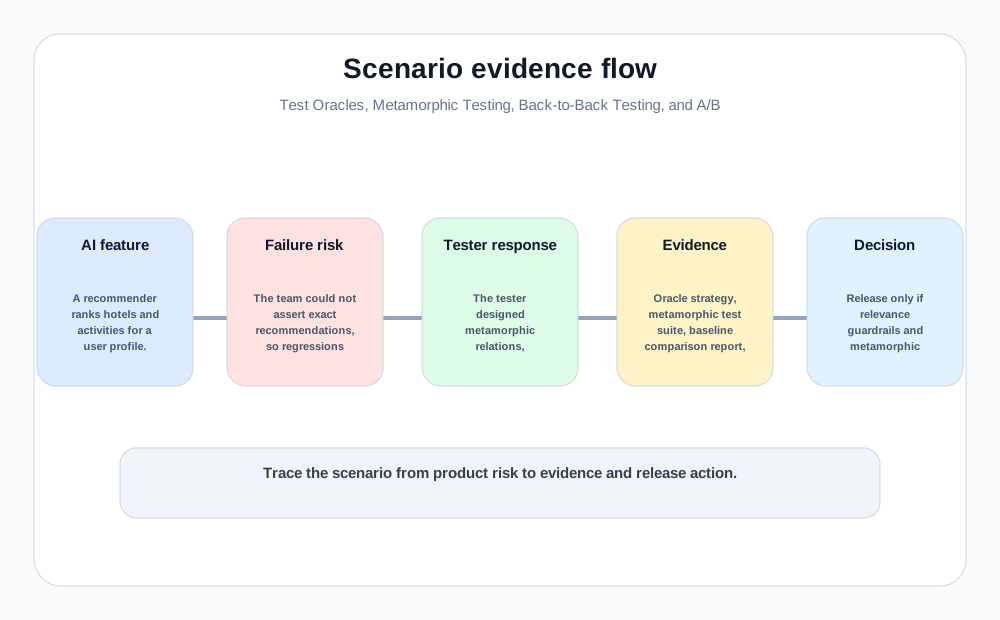
| AI feature | A recommender ranks hotels and activities for a user profile. |
| Failure or risk | The team could not assert exact recommendations, so regressions slipped through when irrelevant hotels started ranking highly. |
| Testing challenge | Testers needed useful oracles without pretending there was one exact expected list. |
| Tester response | The tester designed metamorphic relations, back-to-back comparisons, guardrail metrics, and reviewer rubrics. |
| Evidence required | Oracle strategy, metamorphic test suite, baseline comparison report, A/B guardrails, and review rubric. |
| Business decision | Release only if relevance guardrails and metamorphic relations pass, then monitor through limited rollout. |
Visual flow
Learning path
Start Here
5 minOutcome, CT-AI exam relevance, and the travel recommender scenario.
Learn
22 minOracle selection, metamorphic relations, back-to-back comparison, A/B guardrails, and human rubrics.
See It
10 minRelevance guardrails for recommendations with no single correct answer.
Try It
16 minBuild an oracle strategy for a probabilistic feature.
Recall and Apply
10 minExam traps, active recall, and the portfolio artifact.
Match the oracle to the risk
AI tests do not always need one exact expected output; they need a defensible way to decide whether behaviour is acceptable for the product risk.
Example
The travel recommender can return many valid hotel lists, but irrelevant hotels should not rise when user preferences become more specific.
Mistake
Writing brittle exact-list assertions or accepting any plausible-looking output.
Evidence
Oracle strategy, metamorphic relation catalogue, back-to-back delta report, A/B guardrails, and reviewer rubric.
Worked example: Testing recommendations without exact answers
Scenario. A new recommender changes many ranked hotels. Product says the list still looks plausible, but users start seeing irrelevant options near the top.
Reasoning. Exact rank equality is too brittle, but relevance relations, baseline comparisons, and guardrail metrics can reveal regressions.
Model answer. Release only if agreed metamorphic relations pass, high-risk deltas are reviewed, relevance guardrails remain within tolerance, and the rollout has rollback triggers.
Try it: Build the AI oracle strategy
Prompt. Use the travel recommender scenario to design a test strategy for outputs that do not have one correct answer.
Learner action. Define deterministic checks, metric thresholds, metamorphic relations, back-to-back comparisons, human review criteria, and A/B guardrails.
Expected output. `ai-oracle-strategy.md` with oracle types, example tests, evidence sources, owners, and release recommendation.
Exam trap
Objective
CT-AI 8.7, 9.4, 9.5
Common trap
Assuming probabilistic systems are untestable because exact expected output is hard.
Wording clue
Look for answers that use relations, thresholds, comparisons, rubrics, and controlled experiments.
Portfolio checkpoint
Create the module portfolio deliverable and use it to support your release decision.
Artifact structure
ai-oracle-strategy.md
Recall check
- What is a test oracle?
- A way to decide whether behaviour is acceptable.
- What does metamorphic testing check?
- Expected relationships across related inputs and outputs.
- Why use back-to-back testing?
- It exposes behavioural deltas between versions on the same cases.
- What portfolio artifact does this module produce?
- ai-oracle-strategy.md, a practical oracle strategy for probabilistic AI behaviour.
Topic-by-topic teaching guide
1. The Oracle Problem
A test oracle tells us whether behaviour is acceptable. AI systems often need richer oracles than exact expected values.
| Teaching lens | Practical detail |
|---|---|
| Real QA example | A summary can be acceptable in multiple phrasings but still must be grounded and complete. |
| What can go wrong | Writing brittle exact-output assertions for probabilistic behaviour. |
| How a tester should think | Choose an oracle type that matches the risk. |
| Evidence to collect | Oracle strategy and rationale. |
2. Metamorphic Testing
Metamorphic testing checks relationships that should hold when inputs change in controlled ways.
| Teaching lens | Practical detail |
|---|---|
| Real QA example | Changing letter case in a support ticket should not change its intent classification. |
| What can go wrong | Inventing relations that are not actually true for the product. |
| How a tester should think | Validate each relation with domain experts. |
| Evidence to collect | Metamorphic relation catalogue and test results. |
3. Back-to-Back Testing
Back-to-back testing compares two versions, models, prompts, or providers on the same cases.
| Teaching lens | Practical detail |
|---|---|
| Real QA example | Compare old and new triage models on high-risk historical tickets. |
| What can go wrong | Assuming any difference is bad or any improvement is safe. |
| How a tester should think | Classify differences by risk and expected change. |
| Evidence to collect | Delta report and reviewed sample. |
4. A/B Testing
A/B tests measure live impact with controlled exposure and guardrail metrics.
| Teaching lens | Practical detail |
|---|---|
| Real QA example | A new ranking model may increase conversion but also increase support complaints. |
| What can go wrong | Running experiments without stopping rules or guardrails. |
| How a tester should think | Define hypothesis, metrics, sample, and rollback triggers before launch. |
| Evidence to collect | Experiment plan, guardrail dashboard, and decision log. |
5. Human Review Rubrics
For subjective outputs, reviewers need clear criteria and examples.
| Teaching lens | Practical detail |
|---|---|
| Real QA example | Reviewers score chatbot answers for correctness, completeness, tone, safety, and escalation. |
| What can go wrong | Letting reviewers use personal taste instead of a rubric. |
| How a tester should think | Calibrate reviewers and sample disagreements. |
| Evidence to collect | Rubric, calibration notes, and adjudication log. |
Practical QA workflow
- Start from the user or business decision affected by the AI system.
- Name the AI asset under test: data, feature pipeline, model, prompt, retrieval index, tool, or full workflow.
- Convert the main risk into observable quality signals and release gates.
- Choose the right oracle: deterministic assertion, metric threshold, metamorphic relation, reviewer rubric, comparison, or production monitor.
- Test important slices, edge cases, misuse cases, and change scenarios.
- Record versions, data sources, thresholds, reviewer notes, and decision rationale.
Test design checklist
- What harm could happen if this AI behaviour is wrong?
- Which users, groups, products, regions, or workflows need separate evidence?
- Which metric or observation would reveal the failure early?
- What is the minimum evidence needed for release, shadow mode, rollback, or rejection?
- Who owns the evidence after the model, prompt, or data changes?
Worked QA example
A tester receives a release request for the module scenario. Instead of asking only whether tests pass, the tester writes three release questions: what changed, who could be harmed, and what evidence proves the change is controlled. The answer becomes a small evidence pack: one risk table, one set of representative examples, one automated or reviewable check, and one release recommendation.
Common mistakes
- Treating AI output as a normal deterministic response when the real risk is behavioural.
- Reporting one impressive metric without slices, uncertainty, or business context.
- Forgetting that data, prompts, model versions, and monitoring are part of the test surface.
- Writing governance language that cannot be checked by a tester.
Guided exercise
Use the scenario above and create a one-page evidence plan. Include the decision being influenced, the main risk, the test oracle, the data or examples required, the release gate, and the owner.
Discussion prompt
Where would exact assertions help, and where would they make your AI tests fragile?
Hands-on lab mapping
- Lab: CourseMaterials/AI-Testing/labs/06_using_ai_for_testing_playwright.ipynb
- Task: Design metamorphic checks and back-to-back comparison cases for an AI-assisted workflow.
- Why this lab matters: it turns the module theory into visible evidence that a release approver can inspect.
Decision simulation
A new model changes 30% of outputs but improves one headline metric. Decide what comparison evidence you need before approval.
Key terms
- Test oracle: A mechanism for deciding whether behaviour is acceptable.
- Metamorphic relation: A property expected to hold across related inputs.
- Back-to-back testing: Comparison of two systems or versions on the same cases.
- Guardrail metric: A metric used to prevent unacceptable side effects during an experiment.
Revision prompts
- Explain the module scenario in two minutes to a product owner.
- Name three pieces of evidence you would require before release.
- Identify one automated check and one human-review check.
- Describe how this topic changes after deployment.