AI Testing Mindset, Lifecycle, and QA Role
Establish how AI testing differs from conventional software testing and what a QA professional contributes across the full AI lifecycle.
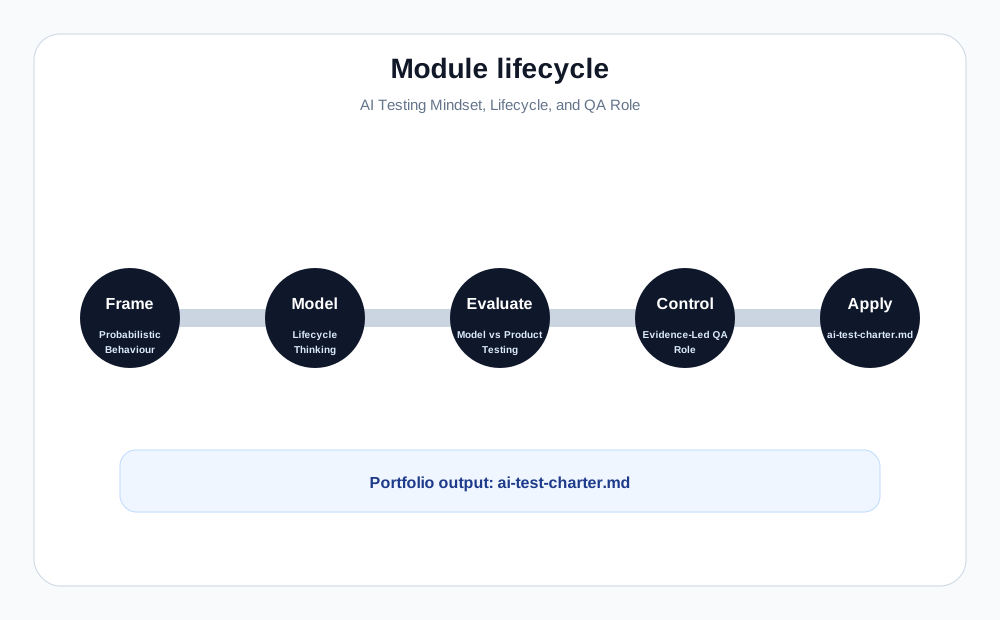
AI Testing Mindset, Lifecycle, and QA Role video briefing
A focused explanation of chapter 1, turning the AI testing theory into concrete validation checks.
Briefing focus
Module opening
This is a structured lesson briefing. Real video/audio can be added later as a media source.
Estimated time
9 min
- 1Module opening
- 2Learning objectives
- 3Mind map
- 4Scenario evidence breakdown
Transcript brief
Establish how AI testing differs from conventional software testing and what a QA professional contributes across the full AI lifecycle. The briefing explains why the topic matters, walks through a failure scenario, and identifies the artefacts a tester should produce for evidence and auditability.
Key takeaways
- Connect the AI risk to a measurable test or monitor.
- Document the evidence needed for reproducibility and audit.
- Use the lab or scenario to practise the validation workflow.
Module opening
Establish how AI testing differs from conventional software testing and what a QA professional contributes across the full AI lifecycle.
Audience. QA engineers, test leads, automation testers, and delivery teams moving from deterministic product testing into AI-enabled products.
Why this matters. Traditional tests can prove that code paths still work, but they cannot alone prove that a model, dataset, prompt, or AI workflow remains trustworthy for the people affected by it.
ISTQB CT-AI mapping. CT-AI 1.1-1.9, 8.7, 10.1
Trainer note
Start with the scenario before the theory. Ask learners what evidence would make them confident, then use the module to build that evidence step by step.
Learning path
Start Here
4 minOutcome, exam relevance, prerequisite terms, and the support-triage scenario.
Learn
18 minFive short concept segments that separate deterministic testing from AI lifecycle evidence.
See It
8 minScenario evidence breakdown and visual flow for the retrained support model.
Try It
12 minBuild a one-page release evidence plan from the scenario.
Recall and Apply
10 minActive-recall checks, exam wording traps, and the portfolio artifact.
Learning objectives
- Explain the core quality risk in ai testing mindset, lifecycle, and qa role.
- Select practical test evidence that supports an AI release decision.
- Apply the module concepts to a realistic QA scenario.
- Produce a portfolio artifact that can be reused in a professional AI testing context.
Mind map
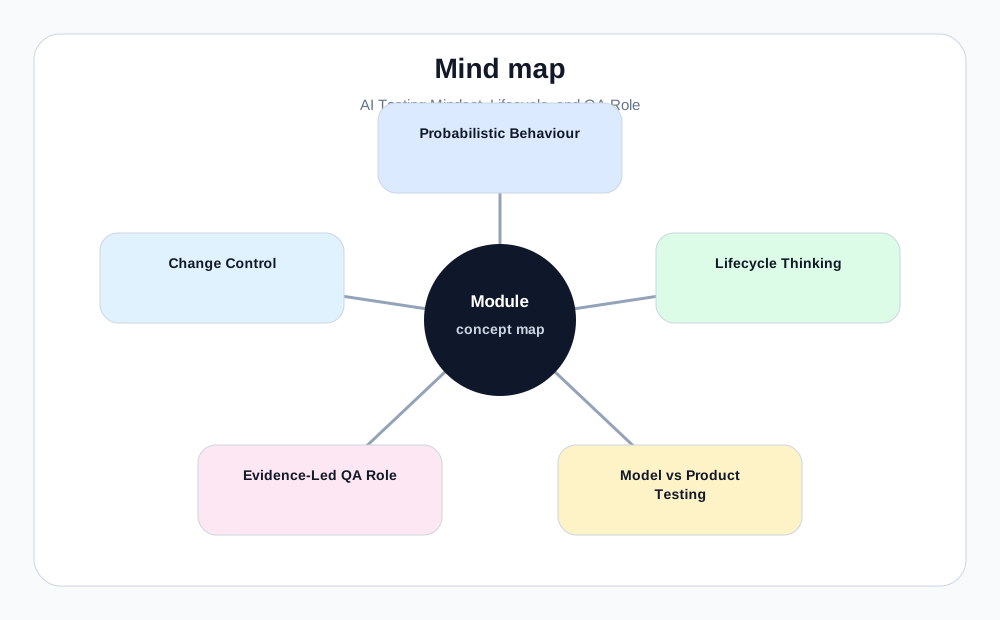
Real-life scenario · Customer support SaaS
The support triage model that passed unit tests but failed users
Situation. A model predicts urgency and routes tickets to specialist queues. A retraining job shifted the confidence distribution, so urgent billing failures were sent to a low-priority queue even though API and UI tests passed.
Lesson. AI testing is strongest when risks, examples, evidence, and release decisions are connected.
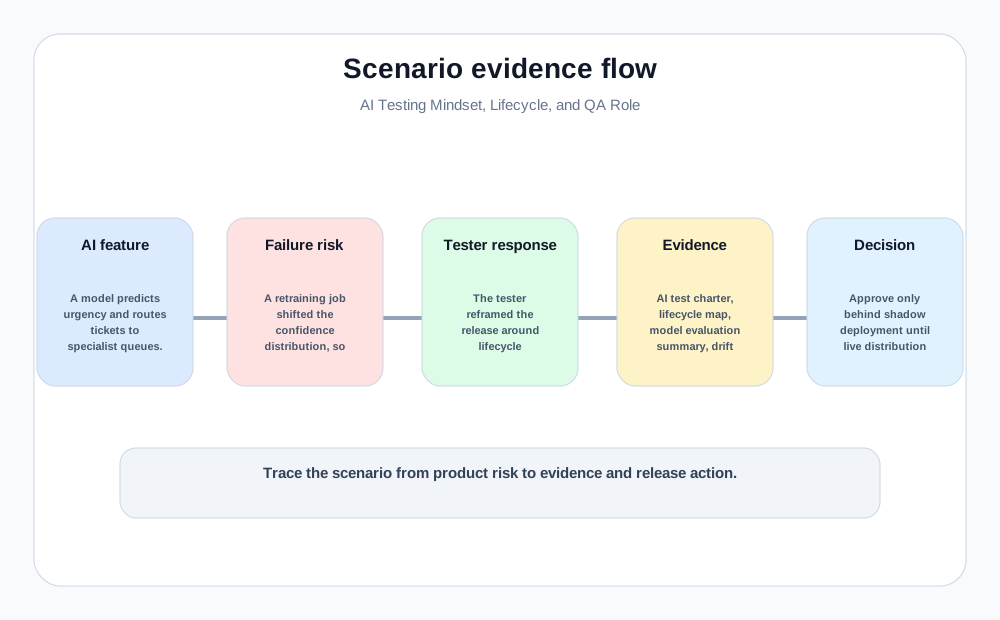
Scenario evidence breakdown
| Scenario element | Detail |
|---|---|
| Product/System | Ticket routing platform |
| AI feature | A model predicts urgency and routes tickets to specialist queues. |
| Failure or risk | A retraining job shifted the confidence distribution, so urgent billing failures were sent to a low-priority queue even though API and UI tests passed. |
| Testing challenge | The QA team had no evidence for data drift, model behaviour by ticket type, threshold changes, or rollback readiness. |
| Tester response | The tester reframed the release around lifecycle evidence: dataset version, model version, threshold rationale, slice metrics, shadow monitoring, and rollback criteria. |
| Evidence required | AI test charter, lifecycle map, model evaluation summary, drift baseline, release gate checklist, and monitoring owner. |
| Business decision | Approve only behind shadow deployment until live distribution and urgent-ticket recall meet agreed thresholds. |
Visual flow
Topic-by-topic teaching guide
1. Probabilistic Behaviour
AI systems often return likely answers rather than fixed answers. A tester therefore evaluates patterns, thresholds, confidence, and consequences, not only exact output equality.
| Teaching lens | Practical detail |
|---|---|
| Real QA example | A payment-risk model may return a fraud probability of 0.81 today and 0.79 after retraining. |
| What can go wrong | Treating every small score movement as a bug, or ignoring large movements because the API contract still passes. |
| How a tester should think | Define tolerances, compare distributions, and record why a difference is acceptable. |
| Evidence to collect | Metric baseline, confidence interval, threshold rule, and decision owner. |
Probabilistic behaviour
AI systems often return likely answers rather than fixed answers, so the test question becomes whether behaviour stays acceptable within agreed tolerances.
Example
A payment-risk model may return a fraud probability of 0.81 today and 0.79 after retraining.
Mistake
Treating every small score movement as a defect, or ignoring large movements because the API contract still passes.
Evidence
Metric baseline, confidence interval, threshold rule, and decision owner.
2. Lifecycle Thinking
AI quality begins before code is written and continues after release.
| Teaching lens | Practical detail |
|---|---|
| Real QA example | A labelling policy change can damage a model months before a release candidate exists. |
| What can go wrong | Testing only the final endpoint and missing upstream data or labelling failures. |
| How a tester should think | Map each lifecycle stage to a quality signal and owner. |
| Evidence to collect | Lifecycle quality map, data lineage, model registry entry, and release checklist. |
Lifecycle thinking
AI quality starts with data, labelling, model design, evaluation, deployment, and monitoring rather than only the final product UI.
Example
A labelling policy change can damage a model months before a release candidate exists.
Mistake
Testing only the final endpoint and missing upstream data or labelling failures.
Evidence
Lifecycle quality map, data lineage, model registry entry, and release checklist.
3. Model vs Product Testing
Model evaluation checks prediction behaviour; product testing checks whether the complete workflow helps users safely.
| Teaching lens | Practical detail |
|---|---|
| Real QA example | A chatbot classifier may be accurate offline but still frustrate customers if the UI hides escalation options. |
| What can go wrong | Reporting model accuracy as if it proves the full user journey is safe. |
| How a tester should think | Test the AI asset and the surrounding workflow together. |
| Evidence to collect | Model report, journey test results, user harm analysis, and escalation checks. |
Model versus product testing
Model evaluation checks prediction behaviour, while product testing checks whether the complete workflow helps users safely.
Example
A chatbot classifier may be accurate offline but still frustrate customers if the UI hides escalation options.
Mistake
Reporting model accuracy as if it proves the full user journey is safe.
Evidence
Model report, journey test results, user harm analysis, and escalation checks.
4. Evidence-Led QA Role
The tester acts as a challenger and evidence designer.
| Teaching lens | Practical detail |
|---|---|
| Real QA example | A tester asks what evidence would convince support, legal, product, and operations to accept the release. |
| What can go wrong | Relying on trust in data scientists or one headline metric. |
| How a tester should think | Ask for reproducibility, traceability, and reviewable release gates. |
| Evidence to collect | Version logs, experiment notes, reviewer sign-off, and audit-ready test summary. |
Evidence-led QA role
The tester acts as a challenger and evidence designer who makes release confidence inspectable across product, data, model, and operations concerns.
Example
A tester asks what evidence would convince support, legal, product, and operations to accept the release.
Mistake
Relying on trust in data scientists or one headline metric.
Evidence
Version logs, experiment notes, reviewer sign-off, and audit-ready test summary.
5. Change Control
Retraining, prompt edits, model provider changes, and embedding refreshes are product changes.
| Teaching lens | Practical detail |
|---|---|
| Real QA example | A prompt tweak improves tone but breaks structured JSON output. |
| What can go wrong | Treating AI changes as content updates that bypass testing. |
| How a tester should think | Require impact analysis and targeted regression packs for AI changes. |
| Evidence to collect | Change request, affected behaviours, regression suite, and rollback plan. |
AI change control
Retraining, prompt edits, model provider changes, and embedding refreshes are product changes that need impact analysis and targeted regression.
Example
A prompt tweak improves tone but breaks structured JSON output.
Mistake
Treating AI changes as content updates that bypass testing.
Evidence
Change request, affected behaviours, regression suite, and rollback plan.
Practical QA workflow
- Start from the user or business decision affected by the AI system.
- Name the AI asset under test: data, feature pipeline, model, prompt, retrieval index, tool, or full workflow.
- Convert the main risk into observable quality signals and release gates.
- Choose the right oracle: deterministic assertion, metric threshold, metamorphic relation, reviewer rubric, comparison, or production monitor.
- Test important slices, edge cases, misuse cases, and change scenarios.
- Record versions, data sources, thresholds, reviewer notes, and decision rationale.
Test design checklist
- What harm could happen if this AI behaviour is wrong?
- Which users, groups, products, regions, or workflows need separate evidence?
- Which metric or observation would reveal the failure early?
- What is the minimum evidence needed for release, shadow mode, rollback, or rejection?
- Who owns the evidence after the model, prompt, or data changes?
Worked QA example
A tester receives a release request for the module scenario. Instead of asking only whether tests pass, the tester writes three release questions: what changed, who could be harmed, and what evidence proves the change is controlled. The answer becomes a small evidence pack: one risk table, one set of representative examples, one automated or reviewable check, and one release recommendation.
Worked example: Release evidence for the support triage model
Scenario. A product owner wants to approve a retrained support-triage model because all API and UI regression tests still pass.
Reasoning. API and UI checks prove that the product can call the model, but they do not prove the retrained model preserves urgent-ticket recall, confidence calibration, slice behaviour, threshold rationale, or rollback readiness.
Model answer. Approve only behind shadow deployment until live-like urgent-ticket recall, drift checks, threshold review, and monitoring ownership meet the agreed release gate.
Common mistakes
- Treating AI output as a normal deterministic response when the real risk is behavioural.
- Reporting one impressive metric without slices, uncertainty, or business context.
- Forgetting that data, prompts, model versions, and monitoring are part of the test surface.
- Writing governance language that cannot be checked by a tester.
Guided exercise
Use the scenario above and create a one-page evidence plan. Include the decision being influenced, the main risk, the test oracle, the data or examples required, the release gate, and the owner.
Try it: Build the evidence plan
Prompt. Use the support-triage scenario to decide what evidence must exist before the retrained model can influence real ticket routing.
Learner action. Name the decision, risk, oracle, data or examples, release gate, owner, and recommendation.
Expected output. A one-page AI test charter that recommends shadow deployment, defines urgent-ticket recall evidence, and names the monitoring owner.
Discussion prompt
Where does your current team have the weakest evidence: data, model, product workflow, monitoring, or governance?
Exam trap
Objective
CT-AI 1.1-1.9
Common trap
Equating passing API or UI tests with sufficient AI model quality evidence.
Wording clue
Favour answers that connect lifecycle stage, risk, oracle, evidence, and release decision.
Portfolio checkpoint
Create the module portfolio deliverable and use it to support your release decision.
Artifact structure
ai-test-charter.md
Hands-on lab mapping
- Lab: CourseMaterials/sandboxes/introduction/
- Task: Classify an AI feature into lifecycle stages and write a first-pass AI test charter.
- Why this lab matters: it turns the module theory into visible evidence that a release approver can inspect.
Decision simulation
A product owner wants to approve a retrained model because all API tests pass. Choose approve, block, or approve behind shadow monitoring and defend the evidence required.
Key terms
- Test oracle: A way to decide whether behaviour is acceptable.
- Model version: A uniquely identifiable trained model artifact.
- AI lifecycle: The chain from idea and data through production monitoring.
- Shadow deployment: Production-like evaluation without letting outputs affect real users.
Revision prompts
- Explain the module scenario in two minutes to a product owner.
- Name three pieces of evidence you would require before release.
- Identify one automated check and one human-review check.
- Describe how this topic changes after deployment.
Recall check
- Why are passing API tests not enough for the retrained support-triage model?
- They prove integration, not urgent-ticket recall, drift, calibration, threshold suitability, or monitoring readiness.
- What should a tester define before accepting probabilistic score changes?
- Tolerances, baseline metrics, confidence intervals, threshold rules, and an accountable decision owner.
- Which AI changes should trigger impact analysis?
- Retraining, prompt edits, model provider changes, embedding refreshes, threshold changes, and data pipeline changes.
- What portfolio artifact does this module produce?
- ai-test-charter.md, a one-page evidence plan for an AI release decision.